Daily Routine and Circadian Rhythm: Why Timing Matters Table of Contents
Many people think circadian health begins and ends with sleep.
They focus on bedtime, the number of hours they sleep, or how often they wake during the night. Those factors matter. But the body’s clock is also paying attention during the day.
It notices when you wake up. When you eat. When you move. When you interact with other people. When activity begins and when the day starts to quiet.
Together, these repeated events create the structure of your biological day.
What the Research Found
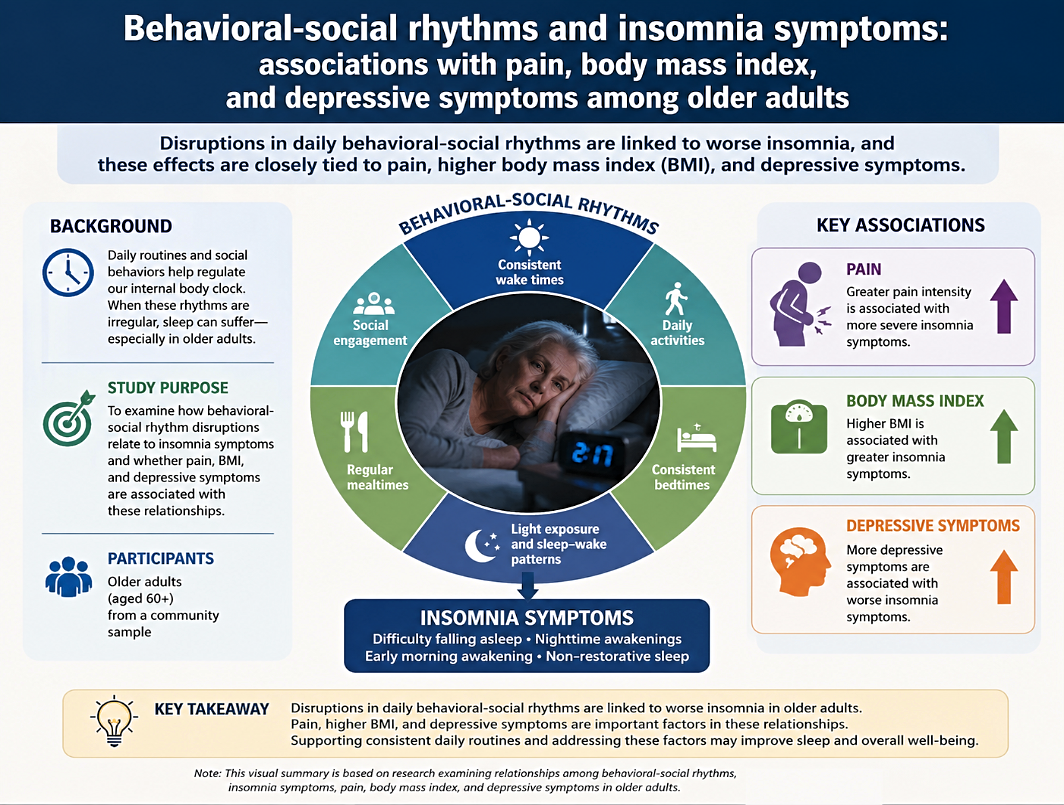
Researchers examined behavioral and social rhythms in a group of older adults with and without insomnia.
Behavioral-social rhythms describe how consistently ordinary daily events occur. These may include sleeping, eating, physical activity, and social interaction.
The researchers found that people with more regular daily rhythms tended to report:
- Less pain
- Fewer depressive symptoms
- Lower body mass index
These associations appeared whether or not the person had insomnia.
This does not prove that a regular schedule directly caused the better outcomes. The study was small, cross-sectional, and relied on self-reported information. It does, however, raise an important possibility: the regularity of the entire day may matter even when sleep is not the person’s main complaint.
Why Daily Routine and Circadian Rhythm Matter
The circadian system does more than determine when you feel sleepy.
It helps coordinate the daily timing of:
- Alertness
- Appetite
- Digestion
- Hormone release
- Immune activity
- Pain sensitivity
- Metabolic function
- Repair and recovery
For these systems to work together, the body needs reliable information about where it is within the day.
Morning light provides one timing signal. Darkness provides another. Meals, movement, work, social contact, and evening routines also help define when the body should activate and when it should begin withdrawing from demand.
When these events happen at widely different times each day, the body receives a less predictable pattern.
It has more timing questions to solve.
A person may still sleep for an adequate number of hours, yet the systems responsible for appetite, mood, pain regulation, energy, and recovery may not be operating within a clearly organized day.
The Clock Does Not Only Track Sleep
One of the most useful findings from this research is that insomnia did not fully explain the relationship between daily rhythm and health.
The people with insomnia reported more pain and depressive symptoms than the good sleepers. But regular behavioral-social rhythms were associated with more favorable outcomes across both groups.
This suggests that circadian health should not be judged only by asking:
“Are you sleeping?”
A broader set of questions may be needed:
- Does your day begin at a reasonably consistent time?
- Do meals arrive within predictable windows?
- Does activity occur at roughly the same part of the day?
- Is there a recognizable transition between daytime engagement and evening recovery?
- Does your schedule change dramatically from one day to the next?
A person can sleep without having a well-organized rhythm.
The night may be adequate while the day remains physiologically unpredictable.
How This Fits Into Healing in Order
Healing in Order teaches that recovery depends on coordination.
The body does not repair itself through isolated systems working independently. The nervous system, immune system, circadian system, gut, metabolism, and cellular-energy systems must receive compatible information.
Daily regularity helps provide that compatibility.
A predictable day tells the body when demand is likely to arrive. This allows systems to prepare rather than react after the demand has already begun.
Digestion can anticipate food.
Alertness can rise before activity is required.
The transition toward sleep can begin before the person enters bed.
Recovery becomes less dependent on improvisation.
This does not mean that life must become rigid. It means that enough of the day becomes recognizable that the body can organize itself around a reliable pattern.
Phase 3: Restoring the Structure of the Day
This research fits most directly into Phase 3 of the Ettinger Foundation Protocol: Circadian Rhythm Restoration.
Phase 3 is not simply a sleep phase.
Its purpose is to restore strong and repeatable timing signals across the day. These signals help the body distinguish:
- Morning from evening
- Activation from recovery
- Feeding from fasting
- Engagement from disengagement
- Daytime demand from nighttime repair
Light and darkness remain the most powerful circadian signals. But wake time, meals, movement, social activity, and evening transitions also help organize the day.
Circadian restoration requires a recognizable daily pattern, not simply an adequate bedtime routine.
Secondary Relevance to Phase 1
Daily predictability also has relevance to Phase 1: Nervous System Stabilization.
A sensitized nervous system spends more time monitoring, predicting, and preparing for what may happen next.
When the timing of daily life changes constantly, that predictive workload remains high. The system must continually update its expectations.
A degree of regularity reduces the number of unanswered questions.
The body begins to learn:
- When the day starts
- When food usually arrives
- When activity is expected
- When stimulation begins to fall
- When recovery becomes possible
Predictability does not remove every stressor. It reduces the effort required to organize around ordinary life.
What This Research Changes
This study does not add a new EFP phase or replace the central role of light, darkness, and sleep timing.
It strengthens and refines an existing EFP concept.
Circadian rhythm should be understood as the organization of the entire day—not simply the timing of sleep.
It also strengthens an important clinical distinction:
A person does not need to report insomnia before whole-day rhythm becomes relevant.
Pain, low mood, variable appetite, weight dysregulation, fatigue, or inconsistent recovery may coexist with an irregular daily pattern even when the person believes they “sleep fine.”
This does not prove that routine is the cause of those problems. It means daily timing deserves to be considered as part of the larger physiologic picture.
Practical Meaning for the Reader
The goal is not to schedule every minute.
Rigid control can become its own form of stress.
Instead, look for a few recurring anchors that make the day recognizable:
- A reasonably consistent wake time
- Predictable meal windows
- Movement during a similar part of the day
- Regular daytime contact or purposeful engagement
- A dependable transition into the evening
- Limited swings between weekday and weekend schedules
The body responds to the overall pattern, not to perfection.
An unusual day does not erase the rhythm created by many consistent ones. What matters is whether the structure of the day is clear often enough for the body to anticipate what comes next.
Final Perspective
The body’s clock does not only track when you sleep.
It learns when your life happens.
Every repeated morning, meal, period of activity, social exchange, and evening transition helps define the shape of the day.
When that shape becomes more predictable, the body has fewer timing questions to solve. It can spend less effort determining what should happen next and more effort carrying out the work of regulation, repair, and recovery.
Healing does not require a perfectly controlled life.
It requires enough order for the body to find its place within the day again.
Research Source
Tracy, E. L., et al.
Behavioral-social rhythms and insomnia symptoms: associations with pain, body mass index, and depressive symptoms among older adults.
Journal of Behavioral Medicine, 49(3), 551–556.
2026.
DOI: 10.1007/s10865-026-00646-6
Additional Articles about Circadian Rhythm







Leave a Comment